
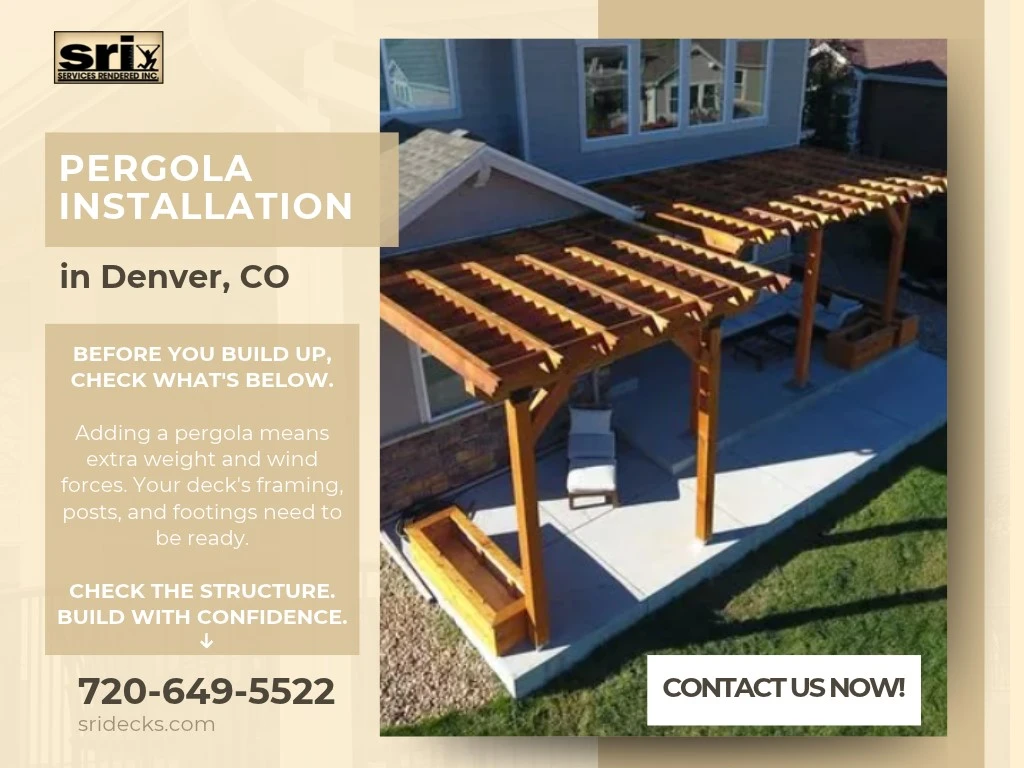
Your deck was built for people, furniture, and the occasional oversized grill, but not necessarily the added weight and wind forces of a pergola. Before planning a pergola installation in Denver, CO, you need to know what your deck can safely support.
Can you add a pergola to an existing deck? Often, yes. But the right approach depends on its framing, footings, condition, and c.onnection to your home. Here’s what SRI Decks considers before construction begins.
Why a Pergola Changes the Math
Residential decks are generally designed to support a minimum uniformly distributed live load of 40 pounds per square foot (psf), representing people, furniture, and typical use. However, this rating does not mean the deck has additional capacity for a pergola. Its existing dead loads, framing, connections, beams, and footings must also be evaluated to determine whether they can safely support the added structure.
A pergola concentrates its weight through a few support posts rather than distributing it evenly across the deck. Without adequate structural support, those added loads can overstress existing joists, beams, or footings.
Then there’s wind. Even an open pergola experiences lateral forces, uplift, and overturning forces during strong gusts. Its posts and connections must transfer those forces safely into the supporting structure and foundation. Attaching posts only to deck boards with surface brackets may not provide the structural resistance required.
The Deck Structural Inspection: What We Look For
Before you add a pergola to an existing deck, a proper deck structural inspection follows the load from top to bottom. Here’s what SRI Decks checks.
The ledger connection. If your deck attaches to the house, its ledger connection is a critical part of the structural system. The type, size, spacing, and installation of fasteners all matter. A properly designed connection must resist the applicable vertical and lateral loads, while flashing helps protect the structure from moisture damage.
Local codes also matter. Louisville’s adopted building code includes specific engineering requirements for decks structurally supported by an existing building. Such decks must be engineered by a Colorado-licensed structural engineer and positively anchored to the primary structure to resist applicable vertical and lateral loads. If the required structural connection cannot be verified during inspection, the deck must be self-supporting. Requirements vary across Front Range municipalities.
Post size and condition. Older decks may have 4×4 posts, but size alone doesn’t determine structural capacity. We assess their condition, bracing, connections, and ability to support additional loads, including signs of rot near the base.
Footings. Are they deep enough? Denver specifies a frost-line depth of 36 inches below finished grade. Footing depth, size, and reinforcement must meet the applicable structural and local code requirements. Inadequate footings can experience movement during freeze-thaw cycles, potentially affecting both the deck and any pergola supported by it.
Joists, beams, and hardware. We look for rusted joist hangers, missing fasteners, and soft spots, plus mismatched hardware that corrodes faster than it should.
Decking material. Composite boards from brands like Fiberon or Deckorators can outlast the wood frame underneath them. A 2026 composite surface on a 2008 frame still has a 2008 frame. If you’re weighing a resurface, our breakdown of composite vs. wood in Colorado’s freeze-thaw cycles is worth a read first.
Four Ways to Get the Pergola You Want
Once the inspection is done, most projects land on one of these approaches.
- Posts down to their own footings. Pergola posts can extend through the decking to independent footings, allowing the structure to transfer loads directly into the ground. This reduces the additional weight placed on existing deck supports, although suitability depends on the property’s layout and structural requirements.
- Posts over existing support. If existing deck beams, posts, and footings align with the proposed pergola supports, they may be usable after a structural evaluation. The design must account for added vertical loads, lateral forces, uplift, and connection requirements. Reinforcement or additional hardware may be necessary.
- Straddle the deck. For a ground-level or low deck, a freestanding pergola can set its posts just outside the deck’s edge, so the structures never touch. It’s a clean solution when the deck framing isn’t worth reinforcing. The independent foundation and post layout must still meet the applicable wind, frost-depth, and structural requirements.
- Attach to the house. An attached pergola ties into the house with its own ledger on one side and posts to footings on the other. This approach requires verification that the home’s structural framing can safely support the proposed attachment. Connections must be designed for applicable loads and properly detailed to protect against water intrusion. Siding alone is not an acceptable structural support.
If your deck fails the inspection, it’s not the end of the road. Sometimes reinforcing a few joists and adding a beam is enough. In other cases, rebuilding portions of the frame may be the safer, more practical solution.
Try This: A Five-Minute Visual Deck Check
Before your SRI Decks consultation, look for these warning signs from a safe location:
- Ledger: Visible gaps, loose connections, or moisture damage where the deck meets the house.
- Posts: Leaning, cracking, or signs of deterioration near the base.
- Hardware: Rusted, missing, or visibly damaged fasteners and connectors.
- Deck surface: Uneven boards, sagging, or suspicious soft spots.
- Stability: Unusual movement you’ve already noticed during normal use.
See something concerning? Take photos without disturbing the structure. Avoid testing questionable areas yourself. A professional assessment can determine whether reinforcement or new pergola post footings are necessary.
When Should You Plan Your Pergola Addition?
Planning ahead gives homeowners time to evaluate their deck, explore structural solutions, and prepare for local permitting. Weather, soil conditions, and municipal approvals can all influence when construction begins.
In Denver, pergolas generally require both zoning and building permits, even when the existing deck was previously approved. The city’s 2025 Building and Fire Code, effective December 31, 2025, also makes it important to verify current requirements.
SRI Decks helps homeowners navigate the design and construction considerations involved in pergola installation in Denver, CO.
Once the structural details are settled, explore our pergola gallery or discover pergola design ideas for Colorado homes.
Frequently Asked Questions
Can any deck support a pergola?
Not without checking. The deck’s posts, beams, footings, and house connection all need to handle the added weight and wind load. Some decks can accommodate a pergola with properly designed reinforcement, while others may require independent supports or more extensive structural work.
Can I bolt pergola posts directly to my deck boards?
No, deck boards alone should not be relied upon to support a pergola’s structural loads. Posts need appropriately designed connections that safely transfer vertical, lateral, and uplift forces through the supporting structure or into dedicated footings. The correct approach depends on the deck’s existing framing and foundation.
Do I need new footings for a pergola on my deck?
New footings are often necessary, especially when the existing deck foundation was not designed for additional structural loads. In some cases, existing supports may be suitable after a structural assessment. The decision depends on footing size, condition, placement, soil conditions, and the pergola’s design. Our concrete partner handles the pour, and we handle everything above it.
How old is too old for a deck to carry a pergola?
Age alone doesn’t determine structural safety. A well-maintained older deck may outperform a poorly built newer one. Framing condition, fasteners, connections, footings, and original construction records provide a better picture.
Will adding a pergola affect my permit?
Yes. Adding a pergola can introduce new building and zoning requirements. Denver’s published residential permitting guidance requires both zoning and building permits for pergolas. Depending on the design, the city may also need structural drawings showing how the new pergola will be supported by the existing deck or separate foundations.
Can Your Existing Deck Handle a Pergola? Find Out With SRI Decks
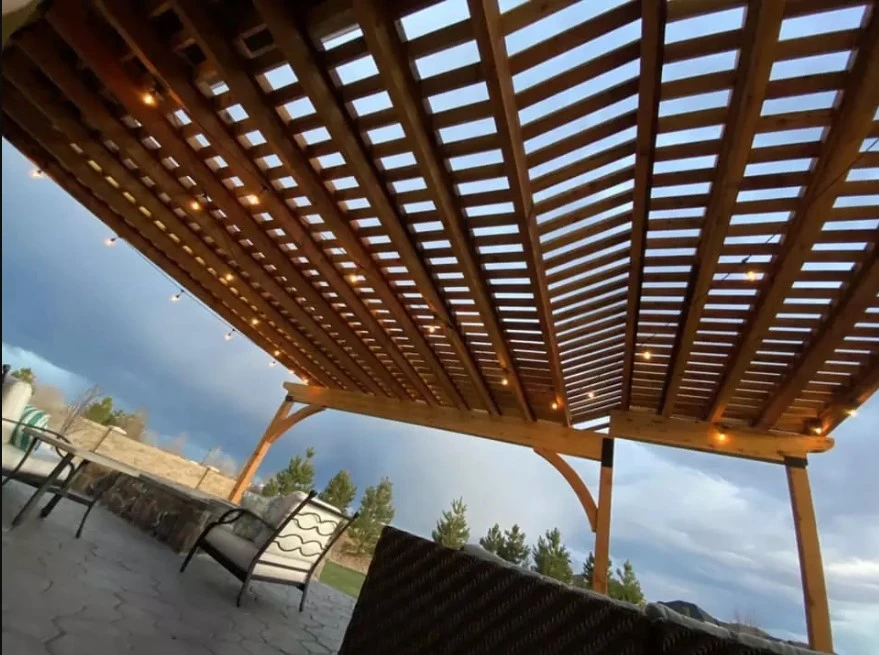
Picture next summer: a beautifully designed pergola overhead, the deck you already love underfoot, and confidence in the structure supporting your outdoor space. The first step isn’t choosing your pergola’s finish. It’s understanding what your existing deck can safely accommodate.
At SRI Decks, we help Denver-area homeowners explore custom pergola designs that complement their outdoor spaces. Whether your deck needs reinforcement, independent pergola footings, or a different structural approach, we’ll help you understand the options before construction begins.
Ready to turn your existing deck into a more comfortable outdoor retreat? Schedule a consultation with SRI Decks to discuss your pergola installation in Denver, CO. Bring photos of your deck, any available construction plans, and the approximate year it was built so we can start the conversation with the right information.
