
Winter brings an increased risk of powerful downslope windstorms along Colorado’s Front Range. When strong winds descend from the mountains, gusts can reach damaging speeds, especially near the foothills. That makes right now the perfect time to ask a smarter question about a patio cover in Denver, CO: not “Will it look good?” but “Will it stay put when an 80-mph gust shows up at 2 a.m.?” Last December, back-to-back windstorms pushed gusts up to 85 mph across parts of the Front Range, and in Denver a couch was blown clean off a high-rise balcony. Here’s how wind actually attacks a patio cover, what local codes require, and what SRI Decks checks so your cover rides out the season looking as good as the day it went up.
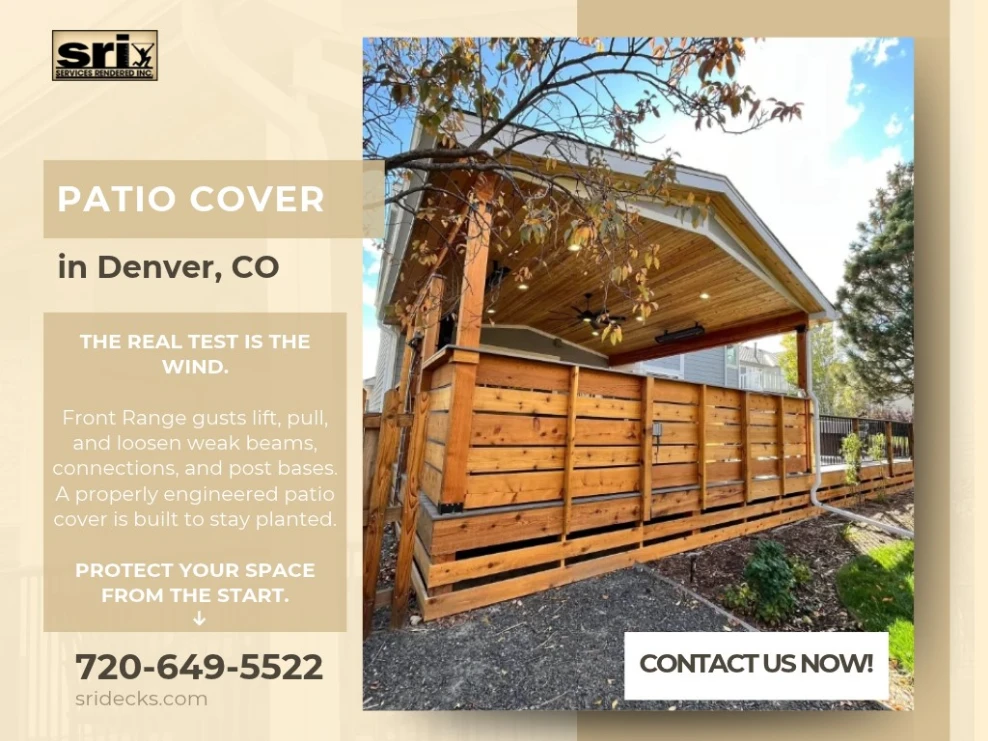
Wind Doesn’t Just Push. It Lifts.
Most people picture a roof holding weight. But a patio cover is open on the sides, so wind gets above and below the roof at the same time.
Air rushing over the top lowers the pressure there. Air ramming in underneath pushes up. Together they create uplift, the same force that flips a patio umbrella inside out.
A closed room fights wind with four walls. A patio cover has only its posts. Every pound of uplift has to travel through the rafter connections, the beams, the post bases, and finally the footings. If any one of those links is weak, that’s where the cover starts to wobble.
Roof style matters, too. An open pergola lets wind pass between its slats. A solid roof catches far more of it, so it needs stronger connections from top to bottom.
What Wind Speed Should a Patio Cover Be Built For?
There’s no single number for the whole metro. Denver sets its own wind criteria in its building code instead of relying on the national hazard maps. Neighboring cities go even more local:
- Lakewood splits its wind design at Kipling Street, with higher values on the west side, closer to the foothills.
- Westminster divides the city into three wind zones, with design speeds from 130 to 150 mph for typical buildings.
These design speeds aren’t weather forecasts. They’re engineering values used to calculate the wind pressures a structure must resist under the applicable building code. Actual performance also depends on exposure, roof geometry, connections, and construction quality.
That’s also why a kit labeled “rated for 90 mph” can be misleading. The right follow-up questions are: rated under which code, and for what exposure? A yard that backs onto open space, a golf course, or a ridge catches much more wind than one tucked between two houses.
Where Wind Finds the Weak Spot
Every set of patio roof structural requirements comes down to a continuous load path. With wind, that path runs in reverse. The force starts at the roof and tries to pull everything up and out.
Roof panels and edges. Wind pressure is strongest at the edges and corners of a roof. Lightweight panels with too few fasteners usually start peeling there first.
Rafter-to-beam connections. A couple of screws driven in at an angle may hold weight, but they can pull loose under uplift. Rated metal ties hold the roof down to the beams.
Post bases. A post resting on a slab with a light bracket can be pried up a little more with every gust. Rated post bases anchored into proper footings below the frost line keep the structure planted.
The ledger. On an attached cover, wind tries to peel the ledger away from the house. That connection needs structural fasteners into solid framing, plus flashing to keep water out.
Sun Belt kits. Many lightweight aluminum kits are engineered for Arizona sun, not Front Range chinooks. They look identical online, but the spec sheet tells the real story.
A Pattern We See: The Three-Year Wobble
Here’s a story we hear more often than we’d like. A homeowner installs a budget kit cover over an existing slab. The first summer, it’s perfect. By the second winter, the post bases have loosened a hair. By year three, the panels rattle in every gust, the whole frame hums, and nobody wants to sit under it on a breezy evening.
Nothing dramatic happened. No single storm took it down. Wind just kept tugging until the weakest connection gave a little, then a little more. That’s the real risk in Denver: not one big event, but a hundred small ones every windy season.
Try This: The 10-Second Wind Check
On a calm day, inspect your patio cover from the ground. Look for loose panels, gaps around post bases, rusted connectors, or fasteners that appear to be backing out. During a windstorm, stay indoors and avoid standing beneath a structure that appears unstable. If you notice unusual movement or damage, arrange a professional inspection.
- Listen. Does anything hum, rattle, or creak?
- Watch the post bases. Do you see movement or a gap opening at the base?
- Look up at the edges. Are any panel corners lifting or any screws backing out?
- Feel the direction. Downslope windstorms usually blow from the west or northwest. Which side of your patio takes the hit?
- Hit record. Take a 10-second video.
Bring that video to your SRI Decks consultation. It tells us more about your yard’s exposure than any map.
How SRI Decks Builds for Front Range Wind
Covered patio construction in Denver should start by reading the site. We look at how open your yard is, how close you are to the foothills, and which direction the strongest gusts arrive from. Then the drawings are sized to your address’s wind and structural requirements under the current code, with rated connections at every link in the load path.
We also handle the paperwork. In Denver, a patio cover is a covered structure, so it needs both a zoning permit and a building permit. SRI Decks helps homeowners navigate the planning, structural, and permitting requirements for covered patio construction in Denver.
Built for wind doesn’t mean built plain. A patio cover in Denver, CO can still feature oversized timber beams, a warm tongue-and-groove ceiling, and integrated lighting. Want a privacy wall on the windy side? Great idea, but it changes how wind loads the whole structure, so it should be designed in from the start, not bolted on later. If you’d rather put your covered space out in the yard, a freestanding pavilion follows the same engineering playbook.
Still weighing the lifestyle side? Compare covered vs. open decks, see how a cover protects outdoor furniture, or browse our patio cover gallery.
Frequently Asked Questions
How much wind can a patio cover handle in Denver?
It depends on the design wind speed for your address, how exposed your yard is, and how well every connection is built. A cover engineered to local code is designed for gusts well beyond what a typical windy day brings.
Is a solid roof or an open pergola better in high wind?
An open pergola generally allows more airflow than a solid patio roof, but that doesn’t make it windproof. Both structures need connections and anchoring designed for their specific geometry and site conditions. A solid roof catches more wind and needs stronger connections. Both perform well when they’re designed for the site.
Can I add a privacy wall or screens to my patio cover later?
Possibly, but walls and screens change how wind loads the structure. It’s best to plan them with the original design, or have the cover checked before adding them.
Do I need a permit for a patio cover in Denver?
Yes. Denver requires both a zoning permit and a building permit for covered structures. SRI Decks handles the applications and inspections for you.
What should I do before a big windstorm?
Retract any shade fabric, secure cushions and umbrellas, and take down hanging décor that can catch the wind. Once a year, check fasteners and post bases for anything loose.
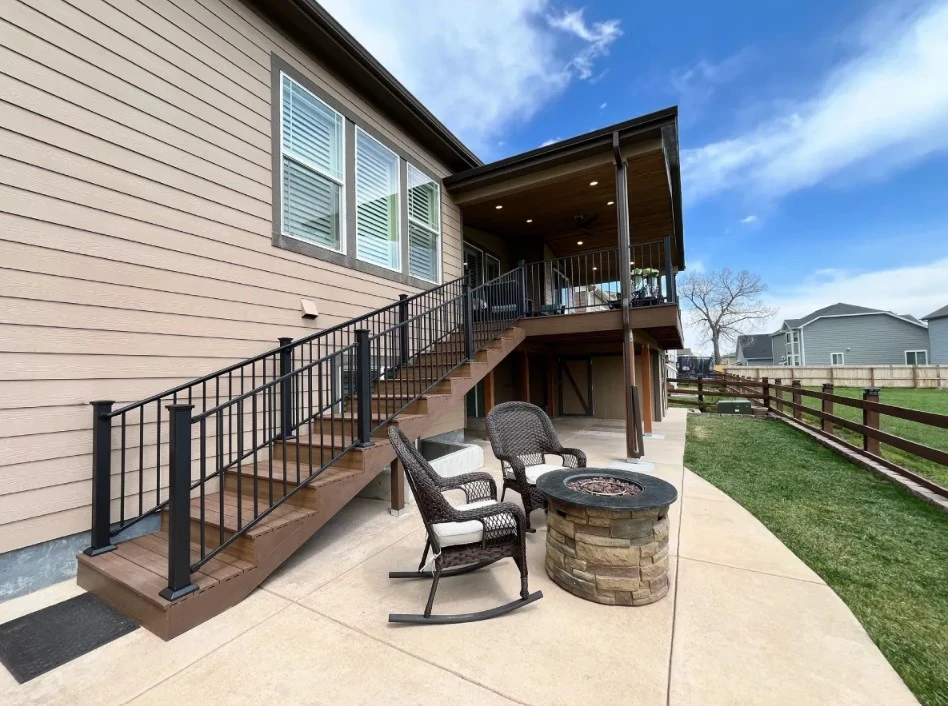
Beat the Windy Season: Book a Wind-Ready Patio Cover Consultation With SRI Decks
December and January bring Denver’s strongest winds, which makes this the ideal window to plan. Design and permits can move forward over the winter, so your build is ready to go when spring arrives.
Ready for a patio cover in Denver, CO, that stays quiet when the wind howls? Run your 10-second wind check, then book a wind-ready patio cover consultation with SRI Decks. We’ll walk your yard, review your design options, and take care of the permits from application to final inspection.
